
Table of Contents
- Understanding Paver Patio Installation Cost in the Fraser Valley
- Paver Patio Cost Factors: Materials and Base Preparation
- Labour Costs for Complex Paver Patio Designs
- Site Excavation and Base Preparation: Impact on Total Cost
- Paver Patio vs. Concrete Slab: Which is More Cost-Effective in BC?
- Frequently Asked Questions About Paver Patio Costs
- Getting Started with Your Paver Patio Project
Understanding Paver Patio Installation Cost in the Fraser Valley
The paver patio installation cost per square foot in the Fraser Valley can range significantly depending on material selection, pattern complexity, and site preparation requirements. We help homeowners and property managers understand these variables so they can budget accurately for their outdoor projects.
The table below outlines typical per-square-foot and total-project costs for common paver options in our service area across the Fraser Valley.
| Project Type | Average Cost per Sq. Ft. (Material + Labour) | Typical Total (500 sq. ft. Patio) |
|---|---|---|
| Concrete Pavers (Standard Grid) | $6–$8 | $3,000–$4,000 |
| Concrete Pavers (Herringbone Pattern) | $8–$12 | $4,000–$6,000 |
| Natural Stone Pavers (Limestone) | $12–$18 | $6,000–$9,000 |
| Natural Stone Pavers (Granite) | $15–$22 | $7,500–$11,000 |
Based on our project experience throughout the region, material choice remains the biggest cost driver, and concrete pavers offer competitive rates for budget-conscious designs while natural stone options like granite deliver a distinctive finish for higher-end installations.
Pattern complexity also has a substantial impact. For example, installing concrete pavers in a herringbone pattern increases the interlocking stone installation cost due to the additional cutting and labor involved. A critical but often overlooked factor is the paver patio base preparation cost. Proper excavation, grading, and compaction of the base layer are essential to prevent future settling and drainage issues, and as recommended by the Canadian Nursery Landscape Association (CNLA), we ensure all base layers meet industry best practices.
Please note that all free quotes are subject to onsite inspection and may be adjusted based on property-specific conditions like soil type, access, and required permits.
For a detailed, competitive quote tailored to your property, contact us for a free consultation on paver patio and deck installation.
Paver Patio Cost Factors: Materials and Base Preparation
Now that we’ve examined why paver patios add value, let’s break down the actual costs — starting with the two biggest drivers: materials and base preparation. Understanding the paver patio installation cost per square foot in the Fraser Valley helps you budget realistically for your project. At Hughes Landscaping Services, we provide transparent pricing based on site-specific factors, and the table below compares costs and lifespans for standard concrete pavers, permeable pavers, and natural stone options.
| Material Type | Material Cost per Sq. Ft. | Labour Cost per Sq. Ft. | Total per Sq. Ft. | Expected Lifespan |
|---|---|---|---|---|
| Concrete Pavers (Standard) | $3–$4 | $3–$5 | $6–$9 | 25–35 years |
| Concrete Pavers (Permeable) | $5–$7 | $4–$6 | $9–$13 | 25–35 years |
| Natural Stone (Bluestone) | $8–$12 | $5–$8 | $13–$20 | 50+ years |
| Natural Stone (Granite) | $10–$16 | $6–$10 | $16–$26 | 50+ years |
The ranges above reflect our own pricing examples for the services described. Material choice directly impacts longevity and upfront investment — standard concrete pavers offer an economical entry point at $6–$9 per square foot, while granite provides a premium finish that can last more than 50 years. Permeable pavers sit in the middle, with added value for drainage management in areas of the Fraser Valley with heavier rainfall.
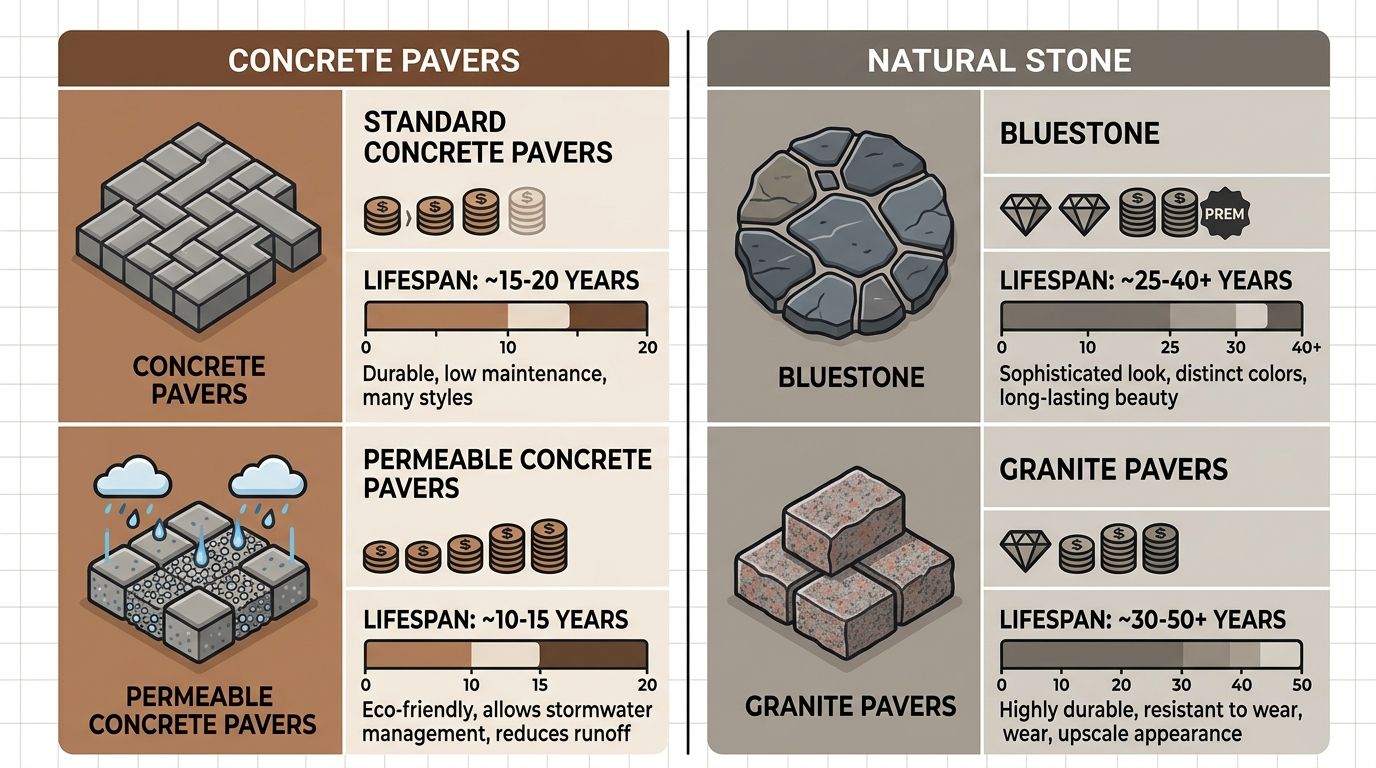
Visual comparison of paver patio materials and costs
Material selection also determines the interlocking stone installation cost, as labour varies with stone density and cutting requirements. Natural stone demands more skill to shape and place, which is reflected in the higher labour component. According to the Canadian Nursery Landscape Association (CNLA), industry best practices for hardscape installation emphasize proper base preparation and professional certification — standards we follow on every project in British Columbia.
Base Preparation and Labour Factors
Paver patio base preparation cost depends heavily on site grading, soil type, and drainage needs. Sandy soils in parts of the Fraser Valley drain well and typically require a 4-inch compacted gravel base. Clay-heavy soils, however, often need 6 inches or more, plus additional drainage layers such as geotextile fabric or perforated pipe, which can add $1–$3 per square foot. The British Columbia Government regulates building codes and zoning rules relevant to patio construction, and we ensure all base work meets provincial standards before placing a single paver.
Labour rates in the table reflect regional costs in the Fraser Valley, where our team provides competitive quotes based on actual site conditions. All figures are estimates and subject to onsite assessment — your final investment will depend on access, existing grade, and the total square footage of your project.
With a clear picture of material and base prep costs, you can start envisioning a custom paver patio design that fits your budget. For homeowners seeking a unique look, our custom paver patio design services can blend material choices and layout patterns — get a free quote to discuss your project.
Labour Costs for Complex Paver Patio Designs
Beyond material costs, the pattern you choose for your patio has a direct impact on installation labour — sometimes adding 30–50% to your per-square-foot rate. We’re breaking down how design complexity drives the overall paver patio installation cost per square foot in the Fraser Valley, so you can plan your budget with confidence.
How Design Complexity Affects Labour Costs
At the heart of any patio install is base preparation and layout, but the design you select determines how much labour is required for cutting, fitting, and alignment. Standard running bond patterns involve linear, repetitive cuts, whereas intricate designs like herringbone or circular fans demand more pieces to be cut at specific angles, increasing cutting waste and requiring more time.
A simple running bond pattern typically adds little to no extra labour beyond the base rate, while a herringbone layout requires 15–25% more labour because every other stone must be cut to interlock precisely. Circular or fan patterns can add 30–50% more labour, as they rely on the eye and skill of a master craftsman to set radii and maintain consistent joint widths. Similarly, incorporating borders or mixing materials pushes the complexity even higher, adding 20–40% in labour markup due to careful transitions and precise joinery.
It is important to remember that paver patio base preparation cost — which covers excavation, gravel compaction, and levelling — is generally independent of pattern choice and should be budgeted separately. The labour markup for complexity applies on top of that base work. Our installers at Hughes Landscaping regularly tackle these challenges across the Lower Mainland, ensuring every pattern is handled with the right level of skill.
Cost Breakdown for Herringbone and Other Common Patterns
To illustrate how pattern choice directly impacts your labour budget, the table below outlines typical costs for common complexities in the 2026 Fraser Valley market.
| Design Complexity | Labour Rate per Sq. Ft. | Additional Markup for Pattern | Typical Skill Level Required |
|---|---|---|---|
| Standard Running Bond | $3–$4 | 0–5% | Experienced Installer |
| Herringbone (90°) | $5–$7 | 15–25% | Skilled Paver Specialist |
| Circular / Fan Pattern | $7–$10 | 30–50% | Master Craftsman |
| Mixed Materials / Borders | $6–$9 | 20–40% | Experienced + Design Skill |
As shown in the table, labour rates for herringbone range from $5–$7 per sq. ft. in the Fraser Valley — a reflection of the extra cuts and precise alignment involved. The interlocking stone installation cost for a herringbone layout is higher than a standard running bond because every second unit must be trimmed to angle exactly. Circular and fan designs push skilled labour to its peak; as the Canadian Society of Landscape Architects notes, precise layout and cutting for radial designs make these the most expensive patterns to install, requiring master craftsmanship. Mixed-material borders add their own layer of coordination, with joinery and transitions that demand measured experience.
These figures represent labour only, and material costs are additional. The right skill level ensures each pattern’s visual impact lasts for years without shifting or settling.
Labour Rates for Professional Paver Installation in the Lower Mainland
According to Landscape Ontario’s 2026 labour guidelines, professional paver installers in the Lower Mainland typically charge $3–$10 per sq. ft. depending on pattern complexity, crew size, and job-site conditions. A crew of two or three experienced installers can complete a standard-sized patio in a few days, while highly intricate designs may require a larger team and more time.
When you need professional paver walkway installation in the Fraser Valley, Hughes Landscaping provides skilled crews and competitive rates. Contact us for a free quote and let’s elevate your outdoor living space with a patio that matches your vision.
Site Excavation and Base Preparation: Impact on Total Cost
When evaluating paver patio installation cost per square foot, the single largest driver often lies underground—the site excavation and base preparation. At Hughes Landscaping, we serve communities from Vancouver to Hope across the Fraser Valley, and we see firsthand how unique site conditions directly shape project budgets. Proper depth, grading, and base materials ensure a patio that withstands the Fraser Valley climate. The table below illustrates how base preparation costs vary by site scenario:
| Site Condition | Excavation Depth | Base Material Needed | Additional Work | Cost per Sq. Ft. (Labour + Material) |
|---|---|---|---|---|
| Flat, Unobstructed Lawn | 6–8 inches | Crushed stone (3/4 in.) + sand | None | $2–$3 |
| Existing Concrete Slab Removal | 4–6 inches (demo) | Crushed stone (3/4 in.) + sand | Demo and disposal (+$1–$2/sq. ft.) | $4–$6 |
| Sloped / Uneven Terrain | 8–12 inches (cut/fill) | Crushed stone (3/4 in.) + geotextile fabric + sand | Grading, retaining wall tie-in, drainage | $5–$8 |
| High Water Table / Poor Drainage | 8–12 inches + drainage system | Crushed stone (3/4 in.) + perforated pipe + sand | French drain, sump pump (if needed), geotextile | $6–$10 |
As the table shows, whether the site is a flat lawn or requires existing concrete removel dramatically changes the labour and material involved. Let’s explore each scenario’s impact on your project.
Understanding Excavation and Grading Costs
Excavation depth typically ranges from 6 to 12 inches, depending on what lies below the surface. A flat, unobstructed lawn needs only 6–8 inches of removal—straightforward and budget-friendly. In contrast, sloped or uneven land demands 8–12 inches of cut-and-fill work, plus additional grading, retaining wall tie-ins, and drainage measures. Removing an existing concrete slab adds $1–$2 per square foot for demo and disposal on top of standard dig costs.
For the same interlocking stone installation cost, these variables can shift labour prices by hundreds of dollars. On a flat yard, interlocking stone installation cost stays low because prep is minimal; on a slope, the expense climbs with the need for heavier machinery and more skilled grading. Our team at Hughes Landscaping works within British Columbia Government building and renovating guidelines to ensure all excavation depths and drainage designs meet provincial codes. We provide free onsite quotes that account for every contour and existing surface, giving you a transparent cost picture before shovels hit the ground.
Base Material Options and Their Costs
A solid patio starts with the right base. The primary aggregate we use is 3/4-inch crushed stone, which delivers structural stability and drainage. A sand leveling layer ensures a smooth surface for pavers. On slopes, high water tables, or where weed control is critical, we add geotexile fabric—installed at an extra $0.50–$1.50 per square foot. This separation layer prevents soil migration and extends the patio’s lifespan.
paver patio base preparation cost depends greatly on material choice. Opting for crushed stone and sand alone keeps the paver patio base preparation cost lower, but sacrificing the fabric on a poor-soil site can lead to future settlement and repair bills. For guidance on base material specificatons, refer to the Landscape Ontario Trade Association. Their standards align with best practices we follow. The Canadian Society of Landscape Architects also stresss proper aggregate compaction and grading to withstand freeze-thaw cycles—advice we apply every day in the Fraser Valley.
Drainage Considerations and Additional Costs
Poor natural drainage or a high water table can turn a simple patio project into a more complex undertaking. When our assessment reveals soggy soil, we often design a French drain with perforated pipe, which typically adds $300–$800 to the job. If the water table is very high, a sump pump may be necessary, pushing the total an extra $400–$1,000. Geotexile fabric plays a dual role here, keeping the base stable while directing water away.
As Hughes Landscaping, we engineer drainage solutions that meet British Columbia’s building standards. Scheduling a site visit early lets us spot these issues before construction begins, ensuring your base preparation is built to last.
Our professional landscape services are designed to deliver Landscaping That Makes Your Yard Look Effortlessly Beautiful. Let’s Elevate Your Outdoor Living—call 604-807-4951 or visit our website to Get a Free Quote. All estimates are subject to onsite inspection, and actual costs may vary with site conditions.
Paver Patio vs. Concrete Slab: Which is More Cost-Effective in BC?
Which is more cost-effective for your BC yard—a paver patio or a concrete slab? When comparing paver patio installation cost per square foot in the Lower Mainland, pavers range from $8–$18 per square foot installed, while a basic concrete slab costs $5–$12. Stamped or coloured concrete can reach $8–$15. However, upfront cost alone doesn’t tell the whole story.
The table below breaks down the key differences between paver patios and concrete slabs in BC.
| Feature | Paver Patio | Concrete Slab |
|---|---|---|
| Initial Cost (per sq. ft., installed) | $8–$18 (material dependent) | $5–$12 (stamped or coloured $8–$15) |
| Lifespan | 25–50 years (with proper base) | 15–30 years (prone to cracking) |
| Maintenance | Low – occasional re-sanding, sealing every 3–5 years | Moderate – sealing every 2–3 years, crack repair |
| Repair Ease | Easy – replace individual pavers | Difficult – cracks require resurfacing or replacement |
| Aesthetic Options | Many patterns, colours, shapes; natural stone look | Limited to stamping, staining, or coloured finishes |
| Resale Value Impact | Typically higher (premium appearance, durability) | Moderate – can be seen as standard |
Interlocking stone installation cost ranges from $8 to $18 per square foot, but its lifespan of 25–50 years—compared to concrete’s 15–30—makes it more cost-effective over time. In BC’s wet, freeze-thaw climate, concrete is prone to cracking, while pavers’ flexibility allows them to shift without damage. Maintenance is also lower for pavers: you only need occasional re-sanding and sealing every 3–5 years, whereas concrete requires sealing every2–3 years and crack repair is far more involved. A key investment in paver longevity is the base; paver patio base preparation cost adds to the initial budget but ensures the surface stays level for decades.
Repair is simpler with pavers—individual units can be replaced easily, whereas concrete cracks may require resurfacing or full replacement. Paver patios also offer far more aesthetic options: patterns, colours, and a natural stone look that consistently boost resale value. According to our experience at Hughes Landscaping, paver projects consistently add more value to Lower Mainland homes.
All our paver installations follow best practices endorsed by the Canadian Landscape Association, ensuring durability and compliance. We offer competitive rates on paver installations, making long-term value even more compelling. Request a free, no-obligation quote to see how a paver patio can transform your Fraser Valley yard.
Frequently Asked Questions About Paver Patio Costs
Now that we’ve covered the cost factors, here are answers to common questions.
What is the average paver patio installation cost per square foot?
Typically between $15 and $30 per square foot, depending on materials and site conditions, according to general renovation cost data from the Government of Canada. For an accurate, site-specific figure, request a free onsite quote from Hughes Landscaping Services.
What factors affect paver patio cost?
Key drivers include paver patio base preparation cost — excavation and compacted gravel bases add to the total — and material choice. For example, the interlocking stone installation cost often runs higher than basic concrete because of the precision cutting and pattern work involved. Labour, access, and overall square footage also influence the final price.
Do I need a permit for a paver patio in British Columbia?
Requirements vary by municipality. For guidance on local building permits and codes, refer to British Columbia government information. We recommend checking with your city or district office before breaking ground.
Costs are estimates; results may vary depending on site conditions and materials. Contact us for a personalised quote.
Getting Started with Your Paver Patio Project
Every successful patio begins with careful planning—measure your intended area now, as this single step shapes everything from your paver patio installation cost per square foot to the design options available. Base preparation is the most critical phase: a properly compacted gravel and sand foundation ensures lasting durability. When considering interlocking stone installation cost and paver patio base preparation cost, remember that site conditions vary. Contact us today for a free onsite quote across the Lower Mainland—we’ll discuss your vision, measure your space, and provide a competitive estimate. From here, let’s explore the design options and material choices that suit your yard.